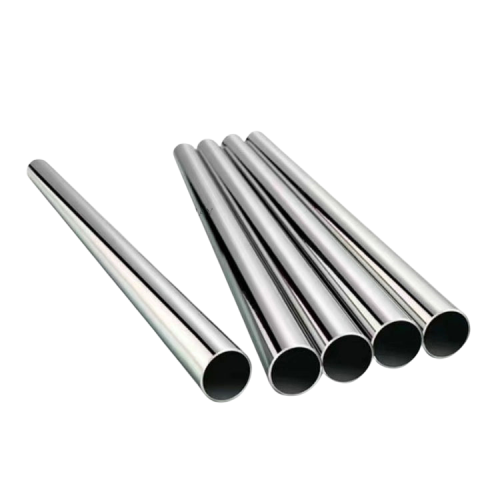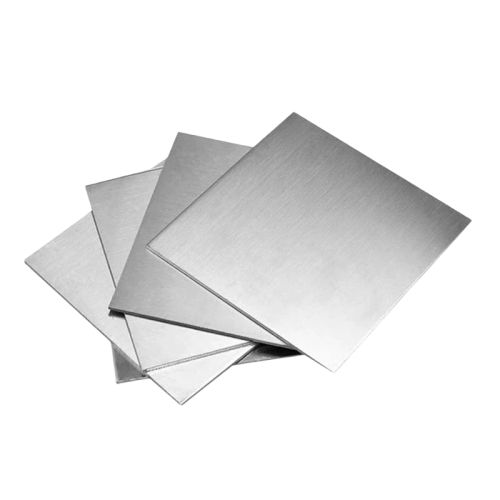
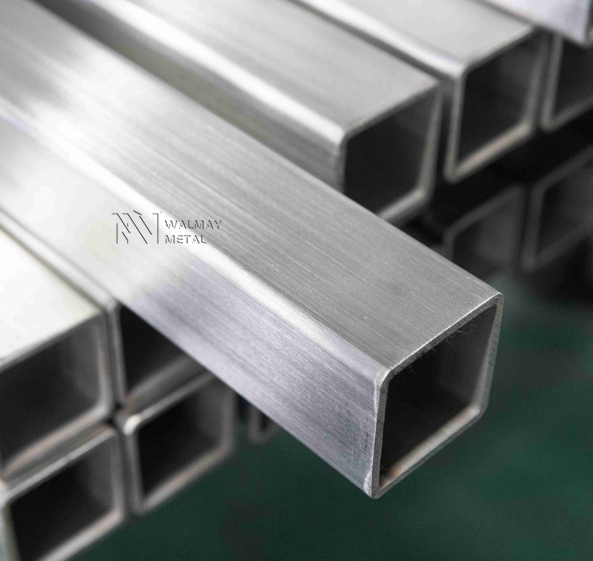
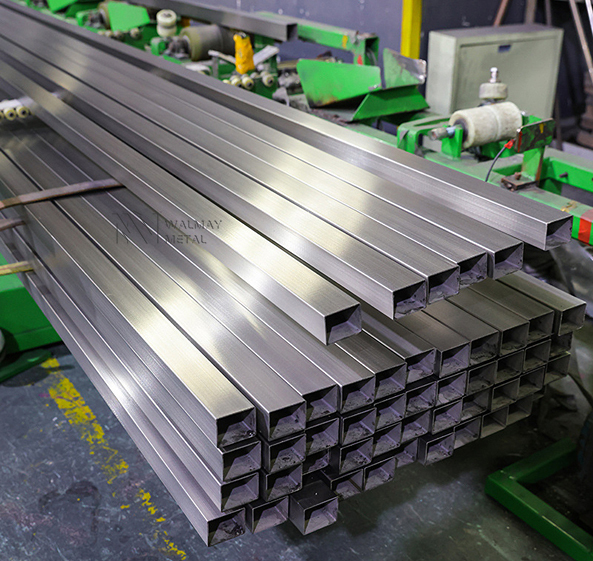
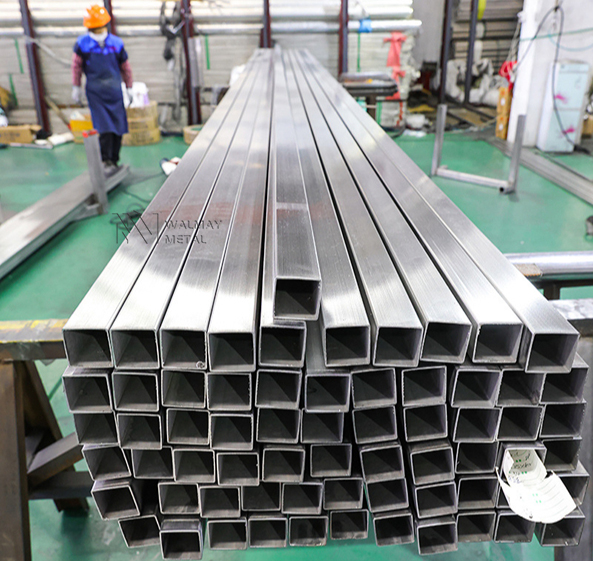
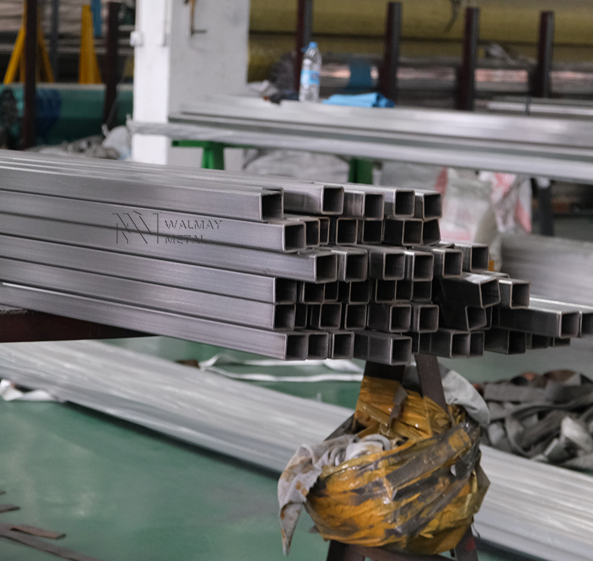
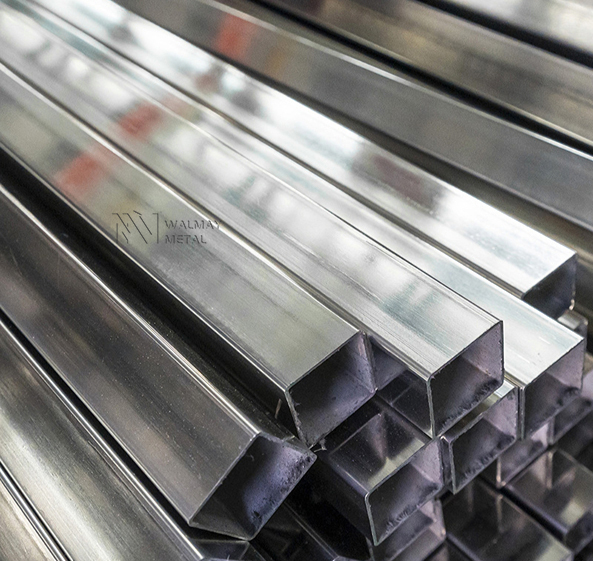
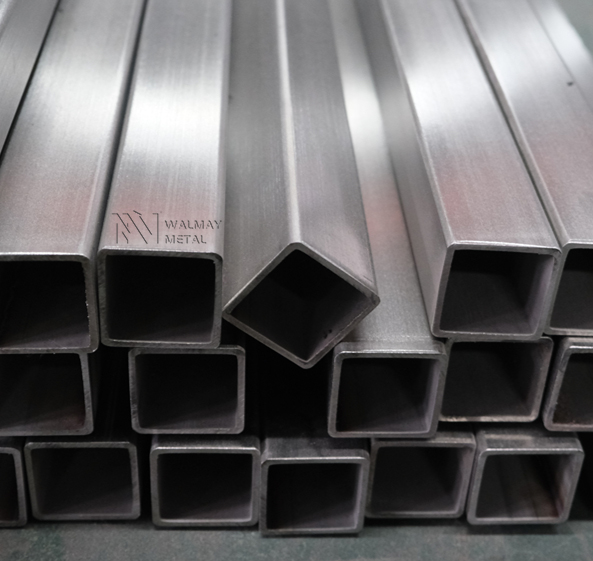
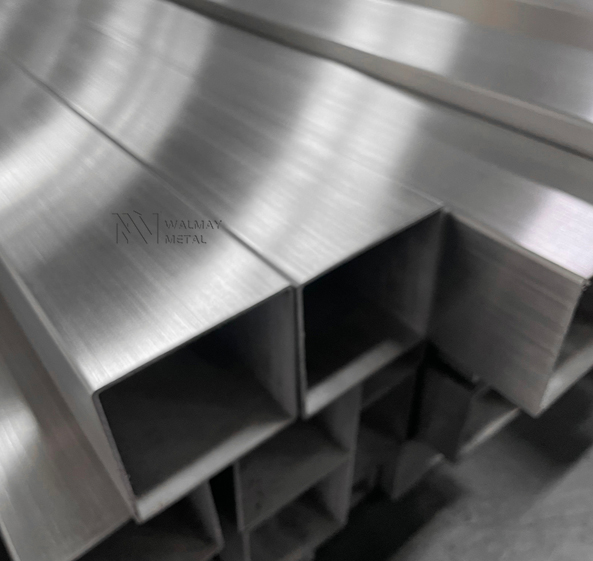
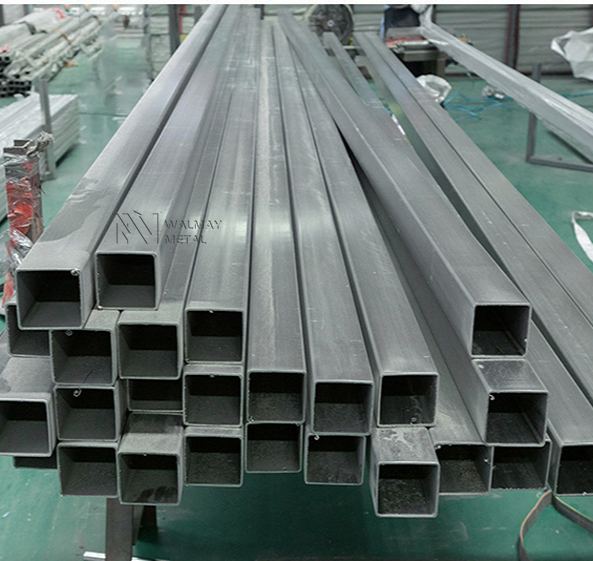
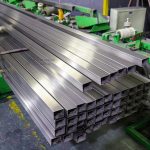
Stainless steel rectangular tube is a welded hollow section supplied to ASTM A554 for structural and architectural service, and to ASTM A778 or A269 where a pressure or mechanical specification applies. Walmay holds 304, 304L, 316 and 316L from 20x10 mm up to 400x200 mm in walls from 0.6 mm to 12 mm, in mill, 180 grit satin, hairline and No.8 mirror finish. Sections are cut to your length list, deburred and end-finished before packing, and every batch carries an EN 10204 3.1 mill test certificate.

| Item | Detail |
|---|---|
| Product | Stainless steel rectangular tube, welded hollow section |
| Standards | ASTM A554 structural and ornamental, ASTM A778 welded unannealed, ASTM A269 mechanical |
| Grades | 304, 304L, 316, 316L, and 201 for indoor decorative use |
| Size range | 20x10 mm to 400x200 mm |
| Wall thickness | 0.6 mm to 12 mm |
| Lengths | 6 m standard, 5.8 m and 6.096 m available, or cut to length |
| Corner radius | Typically 1.5 to 2.5 times the wall thickness |
| Finish | Mill, pickled, 180 or 320 grit satin, hairline, No.8 mirror |
| Certification | EN 10204 3.1 with heat number and full analysis |
Calculated for austenitic grades at 8.0 g/cm3. Weight in kilograms per metre equals 0.016 multiplied by the wall thickness multiplied by the sum of the two outside dimensions less twice the wall, all in millimetres.
| Section | Wall | Weight per metre | Weight per 6 m length |
|---|---|---|---|
| 25x15 mm | 1.5 mm | 0.89 kg | 5.3 kg |
| 40x20 mm | 1.5 mm | 1.37 kg | 8.2 kg |
| 40x20 mm | 2.0 mm | 1.79 kg | 10.8 kg |
| 50x25 mm | 1.5 mm | 1.73 kg | 10.4 kg |
| 50x25 mm | 2.0 mm | 2.27 kg | 13.6 kg |
| 60x40 mm | 2.0 mm | 3.07 kg | 18.4 kg |
| 80x40 mm | 2.0 mm | 3.71 kg | 22.3 kg |
| 80x40 mm | 3.0 mm | 5.47 kg | 32.8 kg |
| 100x50 mm | 2.0 mm | 4.67 kg | 28.0 kg |
| 100x50 mm | 3.0 mm | 6.91 kg | 41.5 kg |
| 120x60 mm | 3.0 mm | 8.35 kg | 50.1 kg |
| 150x100 mm | 4.0 mm | 15.49 kg | 92.9 kg |
| 200x100 mm | 4.0 mm | 18.69 kg | 112.1 kg |
| 200x100 mm | 5.0 mm | 23.20 kg | 139.2 kg |
| Dimension | Tolerance |
|---|---|
| Outside dimension, up to 25 mm | Plus or minus 0.13 mm |
| Outside dimension, 25 to 63 mm | Plus or minus 0.20 mm |
| Outside dimension, 63 to 152 mm | Plus or minus 0.25 mm |
| Outside dimension, over 152 mm | Plus or minus 1 percent |
| Wall thickness | Plus or minus 10 percent |
| Squareness of sides | 2 degrees maximum |
| Twist | 1.3 mm per metre, up to 6.4 mm total |
| Straightness | 0.8 mm per 1.5 m |
| Cut length | Plus 3.2 mm, minus 0 |
| Consideration | Rectangular | Square |
|---|---|---|
| Bending stiffness | Much greater about the major axis | Equal about both axes |
| Best orientation | Load applied across the narrow face | Any direction |
| Typical use | Beams, frame rails, mullions, handrail top rails | Columns, posts, legs, general frames |
| Appearance | Directional, suits horizontal runs | Neutral, suits vertical elements |
The choice is structural. A 100x50 mm section carries roughly four times the bending moment about its strong axis as about its weak axis, so it is the right section for a beam or a rail where the load direction is known. Where load can come from any direction, or where the member reads as a column, square tube is the correct choice.
| Grade | Choose it for | Avoid it for |
|---|---|---|
| 304 / 304L | Indoor and inland outdoor frames, food equipment, general architecture | Coastal exposure, de-iced roads, pool halls |
| 316 / 316L | Coastal and marine, swimming pools, chemical areas, exterior handrail | Cost-driven indoor work, where it is overspecified |
| 201 | Indoor decorative frames and furniture on a budget | Anything exposed to weather or moisture |
The most common specification error on architectural handrail is 304 in a coastal or chlorinated environment. Tea staining appears within months, and while it is cosmetic rather than structural, it is what the client sees. In those locations specify 316L and a 320 grit or finer finish, since a smoother surface holds fewer chloride deposits.
| Finish | Description | Typical use |
|---|---|---|
| Mill | As welded and annealed, dull | Concealed frames, painted or clad assemblies |
| Pickled | Descaled matte grey | Structural work with no cosmetic requirement |
| 180 grit satin | Uniform brushed grain | Handrail, balustrade, the commercial standard |
| 320 grit | Finer grain, smoother | Exterior and coastal work, easier to clean |
| Hairline | Long continuous grain | Architectural facades and feature frames |
| No.8 mirror | Reflective | Decorative frames, signage, retail fit-out |
Polished sections ship with protective PVC film. On welded tube the weld seam is ground flush and polished with the rest of the face, so it should not be visible on a finished 180 grit section.
| Item | Detail |
|---|---|
| Minimum order | 500 kg from stock, 2-3 tonnes for mill-rolled sizes |
| Lead time from stock | 7-12 days to loading |
| Lead time mill run | 25-35 days |
| Packing | Strapped bundles in crates, PVC film on polished sections |
| Incoterms | FOB, CIF, DAP |
Send the section size, wall thickness, grade, finish, length or cut list, quantity and destination port. If the section is structural, send the load case as well and we will confirm that the wall thickness is adequate before quoting.
Related products: square tube, round pipe and tube, seamless pipe and profiles, beams and channels. Company background is on our about us page.
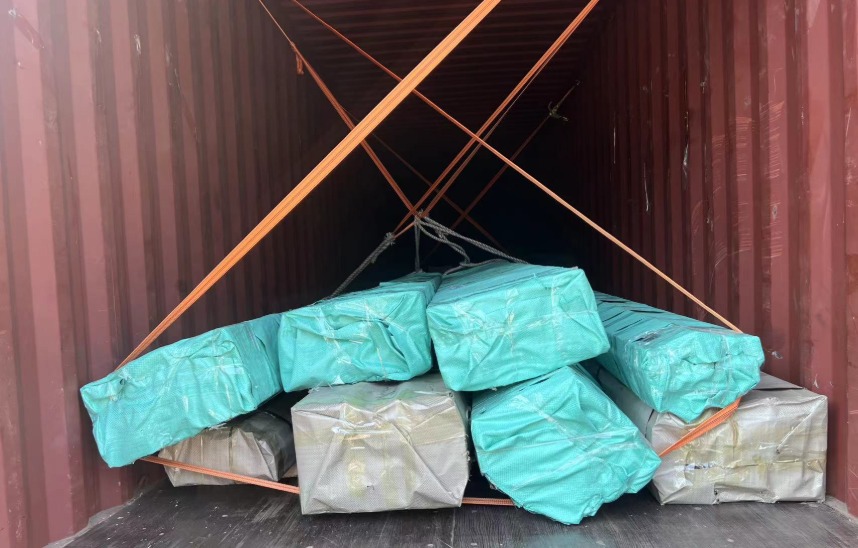
Stainless Steel Tubes Packed in Truck

Wooden Crate Packaging in Factory
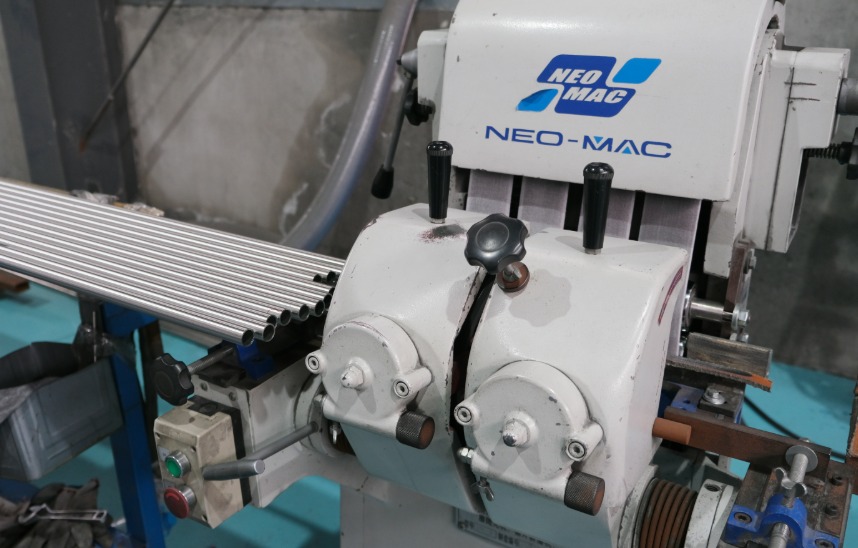
Neo-Mac Machine with Stainless Steel Tubes

Factory Tube Packaging Process

Industrial Manufacturing Equipment
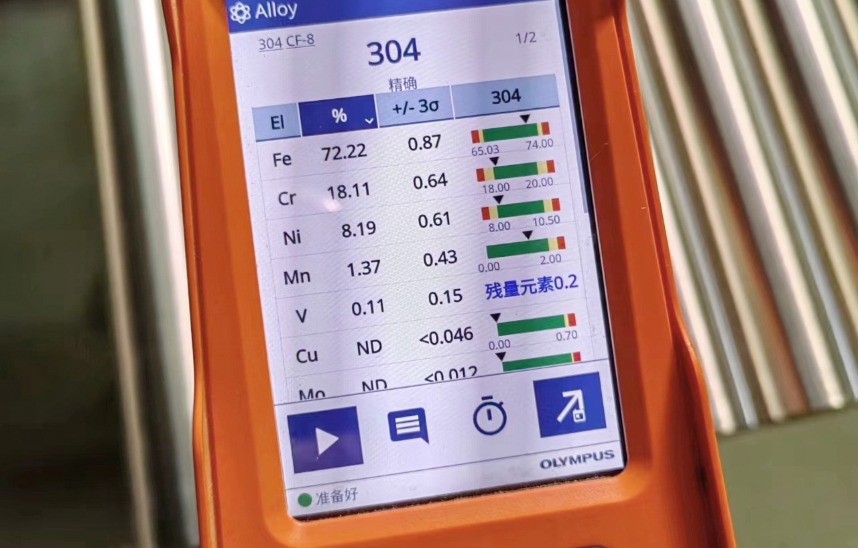
Stainless Steel Composition Analyzer
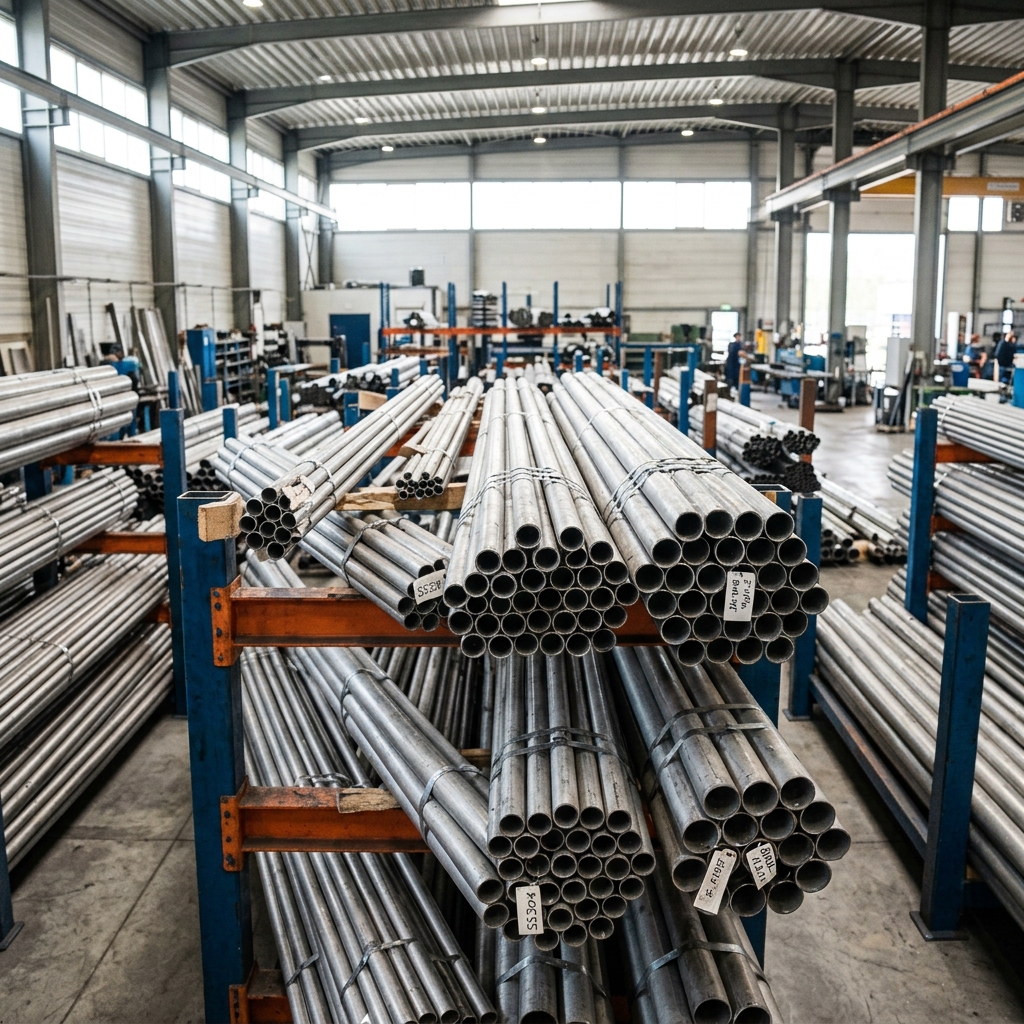
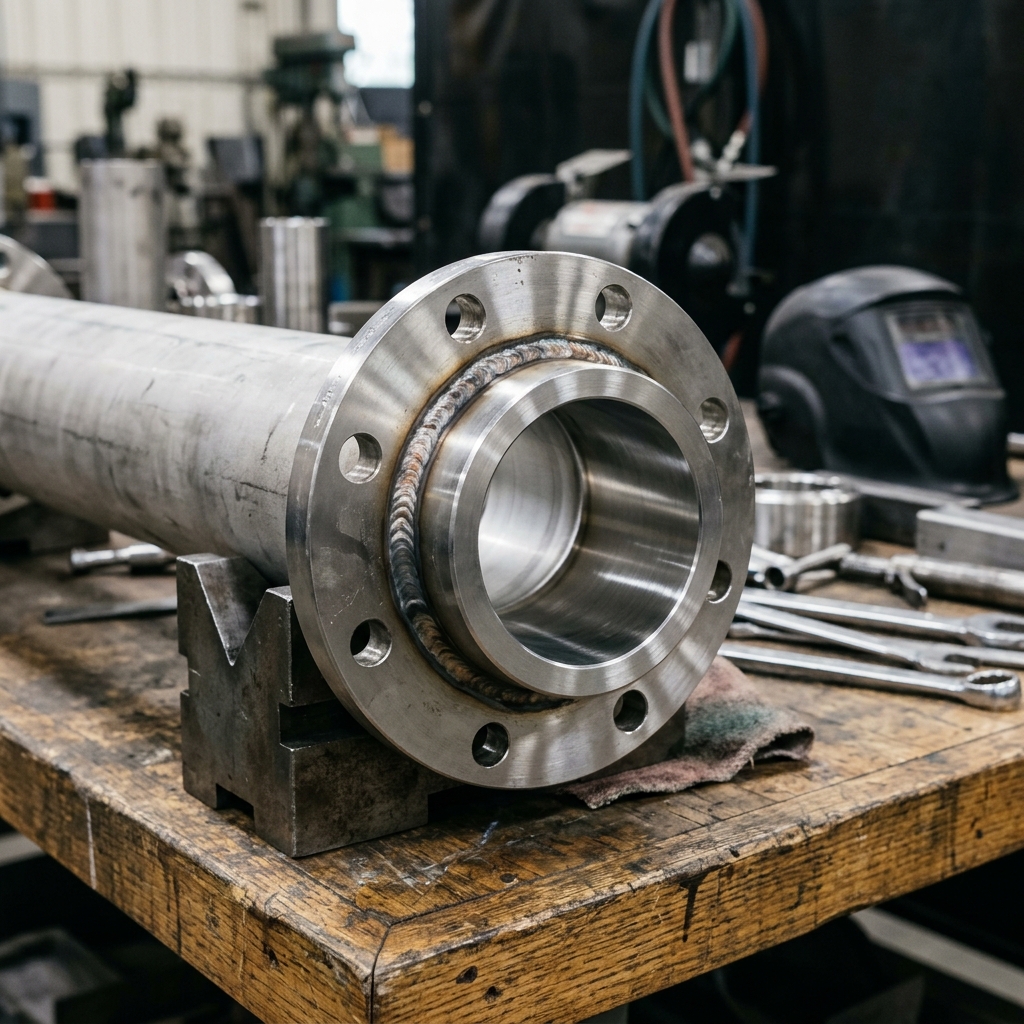
Stainless steel rectangular tube is a welded hollow section supplied to ASTM A554 for structural and architectural service, and to ASTM A778 or A269 where a pressure or mechanical specification applies. Walmay holds 304, 304L, 316 and 316L from 20x10 mm up to 400x200 mm in walls from 0.6 mm to 12 mm, in mill, 180 grit satin, hairline and No.8 mirror finish. Sections are cut to your length list, deburred and end-finished before packing, and every batch carries an EN 10204 3.1 mill test certificate.
The same product carries different names depending on the region and the standard in use, which causes real confusion on international enquiries.
| Name | Where it is used |
|---|---|
| Rectangular tube | North American commercial practice, ASTM A554 |
| RHS, rectangular hollow section | Europe, Australia and Asia, EN 10219 and EN 10210 |
| HSS, hollow structural section | North American structural engineering, covering square, rectangular and round |
| Box section | Informal British usage |
| Rectangular pipe | Occasionally used but technically incorrect, since pipe implies a nominal size and schedule |
The distinction that matters commercially is that a rectangular hollow section is always specified by its actual outside dimensions and wall thickness, never by a nominal size and schedule. There is no schedule system for rectangular sections, so state height, width and wall in millimetres or inches.
Buyers frequently compare a rectangular hollow section with an open channel of similar weight. For most applications the closed section wins, and torsion is the reason.
| Property | Rectangular tube | C channel |
|---|---|---|
| Torsional rigidity | Very high, closed section carries shear in a continuous loop | Very low, open section warps under twist |
| Bending about the major axis | Good, material distributed to both flanges | Comparable at similar depth |
| Lateral torsional buckling | Highly resistant | Prone, often needs restraint |
| Bolting and access to the inside | Requires access holes or blind fasteners | Open, easy access |
| Corrosion behaviour | No crevices, drains if detailed correctly | Traps water and debris in the channel |
| Appearance | Clean on all four faces | One open face |
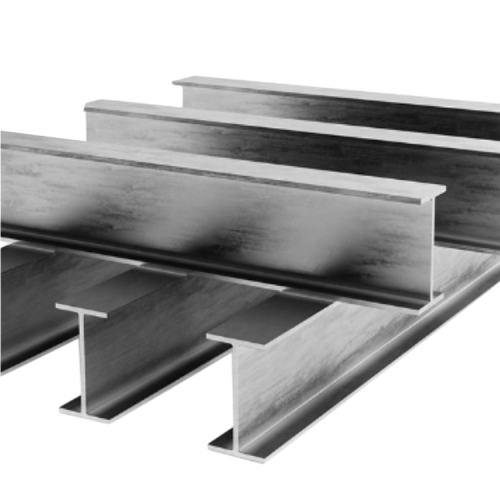
For a member carrying torsion, spanning without lateral restraint, or exposed to weather, the rectangular tube is substantially better. Choose the channel where you need to bolt through the web repeatedly or run services inside it. Walmay also supplies channel, angle and I-beam sections where the open profile is the right answer.
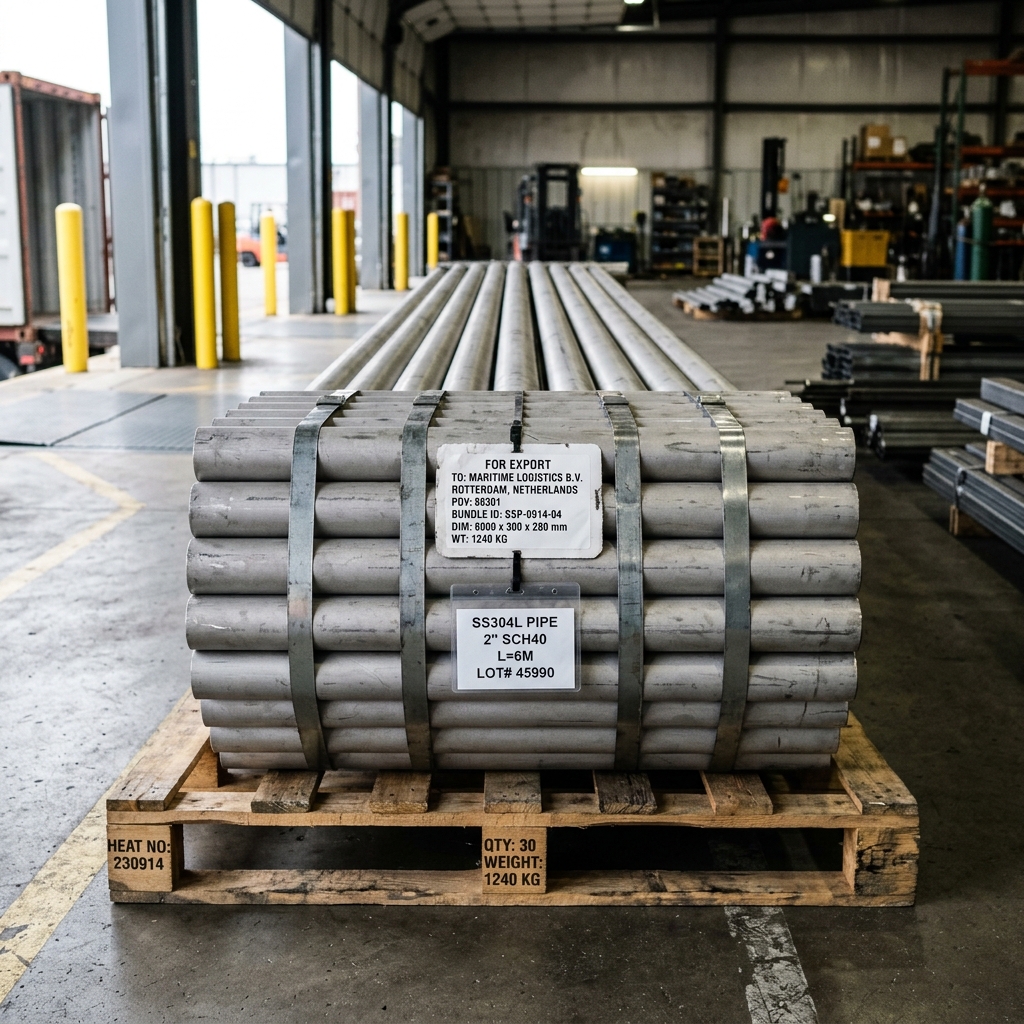


Walmay will help match the right stainless product form and specification for your application, confirm quantities and packing needs, and provide requested documents based on order requirements.
Loading form…