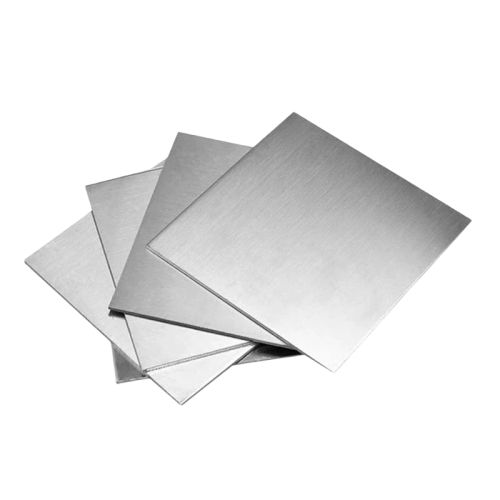
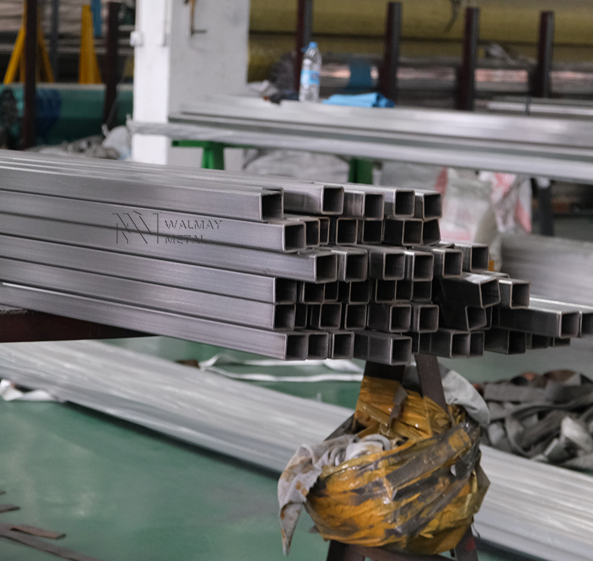
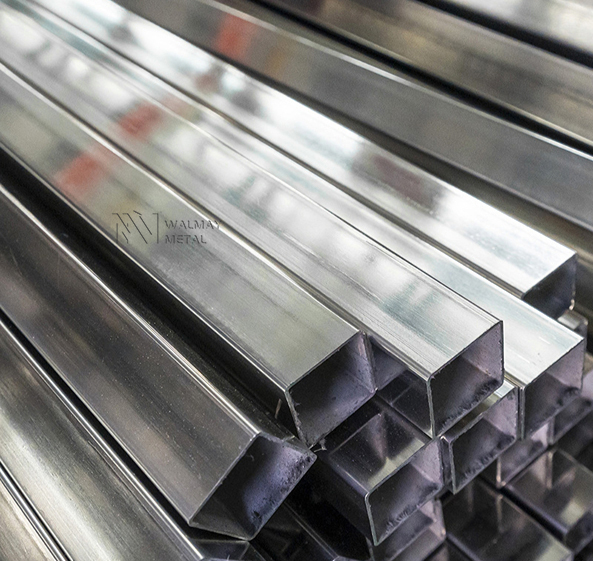
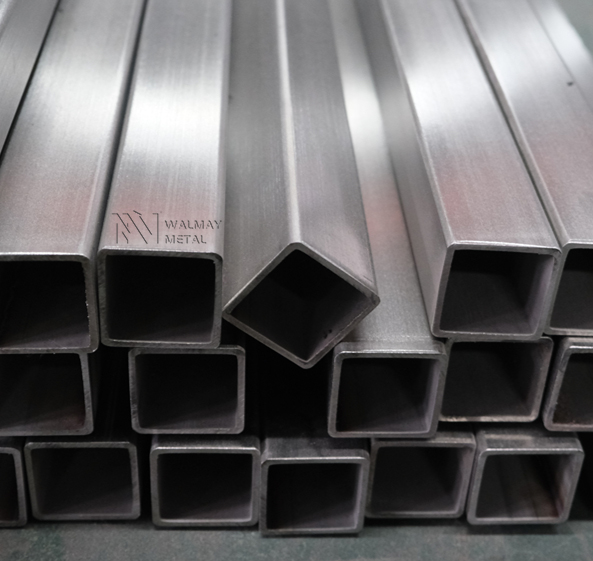
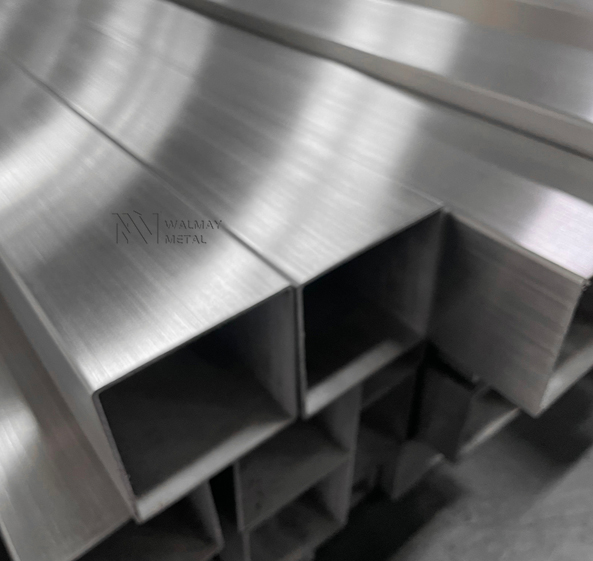
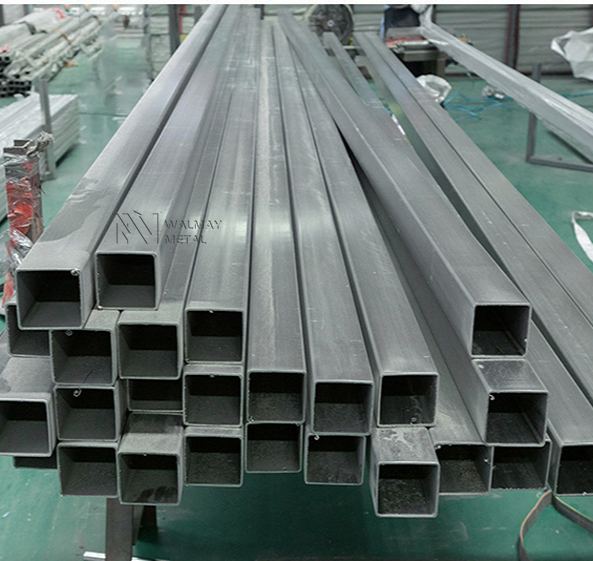
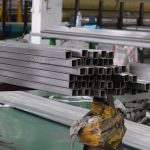
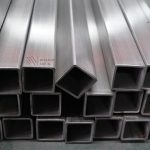
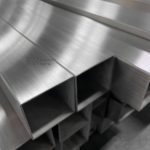
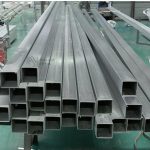
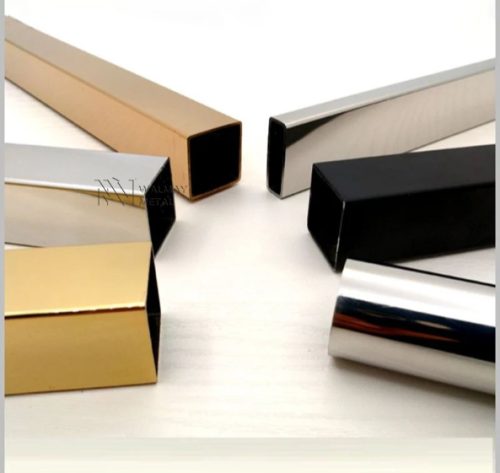
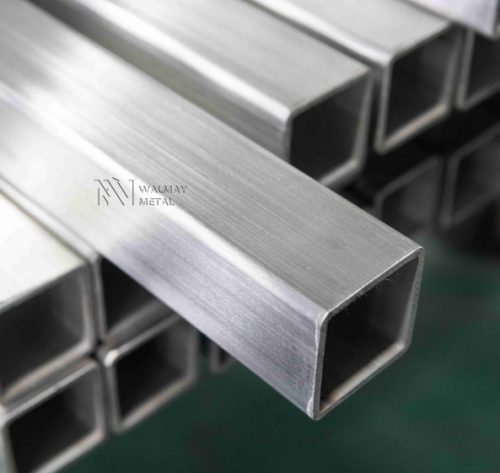
Stainless steel square tube is a hollow square section used for frames, structures, handrails, furniture and machine guarding. It is welded from strip and sized on its outside dimensions, so a 50x50 mm tube measures exactly 50 mm across each face. Walmay stocks it in 304 and 316L from 12x12 mm to 200x200 mm with walls from 1.0 mm to 6.0 mm, in mill 2B, No.4 brushed and mirror finishes, cut to length with square or mitred ends. Standard mill length is 6 metres.
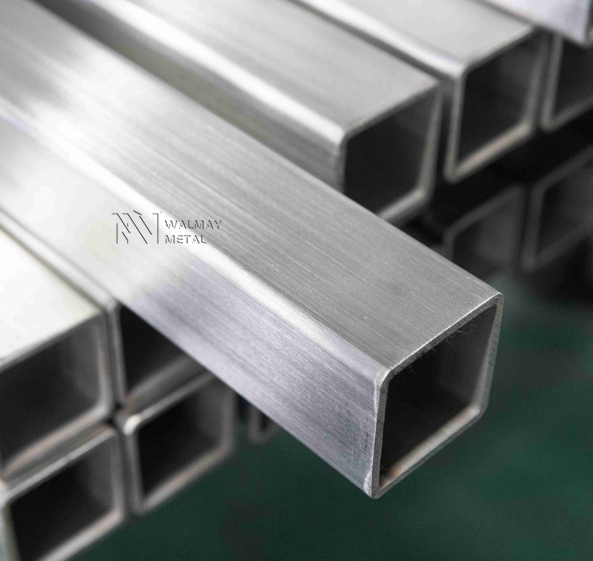
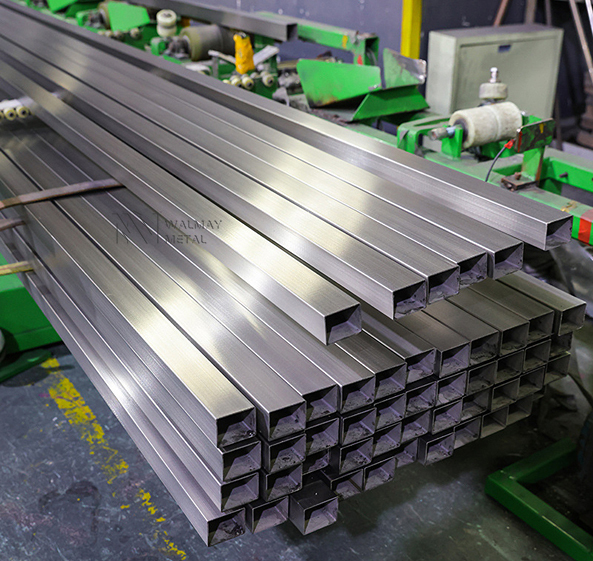
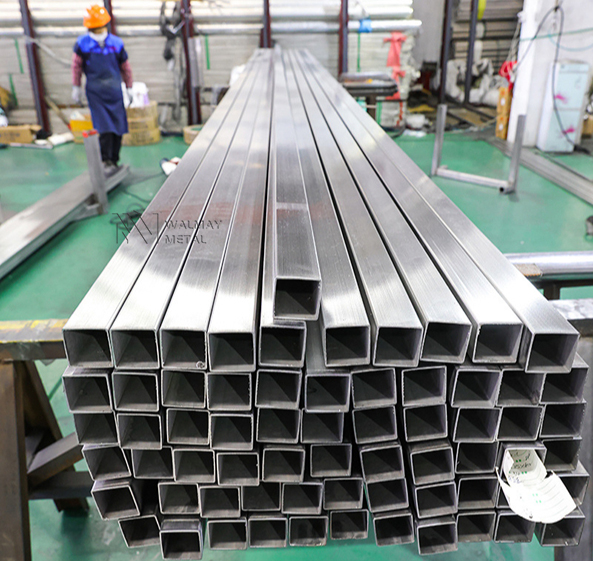

Weights calculated for 304 at 8.0 g/cm3. For a square tube the section area is 4 multiplied by wall thickness multiplied by (side minus wall).
| Size | 1.2 mm wall | 1.5 mm wall | 2.0 mm wall | 3.0 mm wall | Weight per 6 m at 2.0 mm |
|---|---|---|---|---|---|
| 12x12 mm | 0.41 kg/m | 0.50 kg/m | 0.64 kg/m | - | 3.8 kg |
| 20x20 mm | 0.72 kg/m | 0.89 kg/m | 1.15 kg/m | 1.63 kg/m | 6.9 kg |
| 25x25 mm | 0.91 kg/m | 1.13 kg/m | 1.47 kg/m | 2.11 kg/m | 8.8 kg |
| 30x30 mm | 1.11 kg/m | 1.37 kg/m | 1.79 kg/m | 2.59 kg/m | 10.8 kg |
| 40x40 mm | 1.49 kg/m | 1.85 kg/m | 2.43 kg/m | 3.55 kg/m | 14.6 kg |
| 50x50 mm | 1.87 kg/m | 2.33 kg/m | 3.07 kg/m | 4.51 kg/m | 18.4 kg |
| 60x60 mm | 2.26 kg/m | 2.81 kg/m | 3.71 kg/m | 5.47 kg/m | 22.3 kg |
| 75x75 mm | 2.84 kg/m | 3.53 kg/m | 4.67 kg/m | 6.91 kg/m | 28.0 kg |
| 80x80 mm | - | 3.77 kg/m | 4.99 kg/m | 7.39 kg/m | 29.9 kg |
| 100x100 mm | - | 4.73 kg/m | 6.27 kg/m | 9.31 kg/m | 37.6 kg |
| 120x120 mm | - | - | 7.55 kg/m | 11.23 kg/m | 45.3 kg |
| 150x150 mm | - | - | 9.47 kg/m | 14.11 kg/m | 56.8 kg |
| 200x200 mm | - | - | - | 18.91 kg/m | 113.5 kg at 3.0 mm |
In imperial sizes we stock 1/2, 3/4, 1, 1 1/4, 1 1/2, 2, 2 1/2, 3 and 4 inch squares in 16, 14, 12 and 11 gauge walls. A 20 foot length of 2 inch square tube in 14 gauge weighs about 21 kg, which is the figure to apply against a per-tonne price.
| Item | Detail |
|---|---|
| Grades | 304, 304L, 316L, 201 for indoor cost-driven work |
| Standard | ASTM A554 ornamental and structural, ASTM A500 dimensional practice on request |
| Size range | 12x12 mm to 200x200 mm, 1/2 in to 4 in |
| Wall thickness | 1.0-6.0 mm, 20 gauge to 1/4 in |
| Length | 6 m standard, 20 ft, or cut to length |
| Finish | Mill 2B, No.4 brushed, hairline, No.8 mirror |
| Corner radius | Typically 1.5 to 2.5 times wall thickness |
| Weld seam | Inside, bead rolled or ground on request |
| Certification | EN 10204 3.1 |
| Parameter | Tolerance |
|---|---|
| Outside dimension, up to 25 mm | Plus or minus 0.13 mm |
| Outside dimension, 25-75 mm | Plus or minus 0.25 mm |
| Outside dimension, above 75 mm | Plus or minus 1 percent |
| Wall thickness | Plus or minus 10 percent |
| Squareness of sides | 90 degrees plus or minus 2 degrees |
| Straightness | 1 mm per metre, 3 mm maximum over 6 m |
| Twist | 2 degrees maximum per 3 m |
| Length, cut to size | Plus or minus 1 mm |
If a frame is being jigged and welded, ask about the corner radius as well as the dimensions. It varies with wall thickness and mill, and a design that assumes a sharp corner will not sit flush against a section with a 5 mm radius.
| Criterion | Square tube | Rectangular tube | Round tube |
|---|---|---|---|
| Flat faces for joining | Yes, four | Yes, four | No, needs coping or saddles |
| Bending strength for the same weight | Good, equal both axes | Best in the strong axis | Moderate |
| Torsional rigidity | High | High | Highest for a closed section |
| Fabrication cost | Low, simple cuts | Low | Higher, profiled cuts |
| Fixing surfaces | Easy, plates sit flat | Easy | Needs shaped washers or saddles |
| Typical use | Frames, posts, guarding | Beams, spans, rails | Handrails, decorative, fluid |
Square tube wins on fabrication economics rather than on structural efficiency. Cuts are square, plates and brackets sit flat, and welds are straight lines, so a square frame costs less to build than the equivalent round one even when it weighs slightly more. Where a member spans and bends about one axis, rectangular tube placed with its long face vertical uses the material better.
| Application | Grade | Finish |
|---|---|---|
| Interior furniture, retail fittings | 201 or 304 | No.4 or mirror |
| Interior handrails and balustrades | 304 | No.4 or hairline |
| Kitchen and food equipment frames | 304 | No.4 |
| Machine frames and guarding | 304 | Mill 2B |
| Exterior architectural, inland | 304 | No.4 or hairline |
| Coastal exterior, pool halls | 316L | No.4 |
| Marine and deck structures | 316L | No.4 or mirror |
Polished square tube arrives with PVC film on the finished faces. Keep the film on through fabrication and remove it after installation, and note that the weld seam side is normally left unpolished on mill-finished tube, so specify the orientation if one face will be hidden.
| Item | Detail |
|---|---|
| Minimum order | 500 kg from stock, 2 tonnes for mill sizes |
| Lead time from stock | 7-12 days |
| Lead time mill run | 25-40 days |
| Stock range | 20x20 to 100x100 mm in 1.2-3.0 mm wall, 304 and 316L |
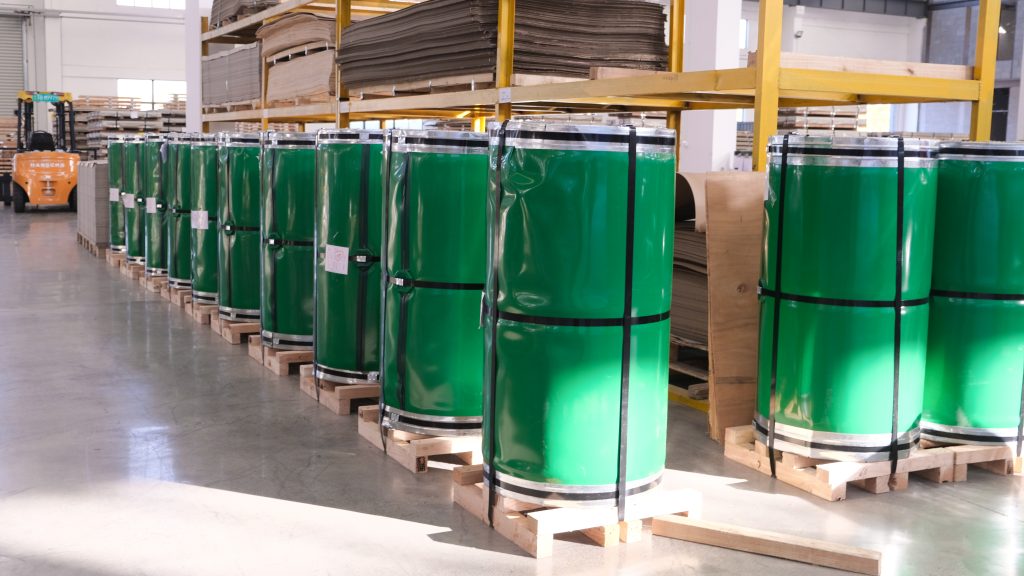
| Packing | Bundled, plastic end caps, film on polished faces |
| Incoterms | FOB, CIF, DAP |
Send the section size, wall thickness, grade, finish, length or cut list, and whether ends should be square or mitred. Related products: rectangular tube, 304 pipe and tube, 316 pipe and tube, angle bar, channel, and the full pipe and tube range.
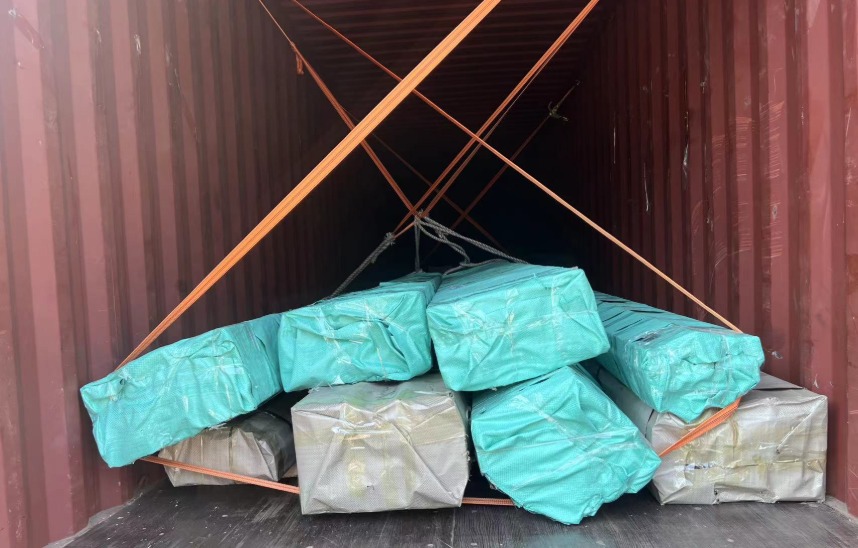
Stainless Steel Tubes Packed in Truck

Wooden Crate Packaging in Factory
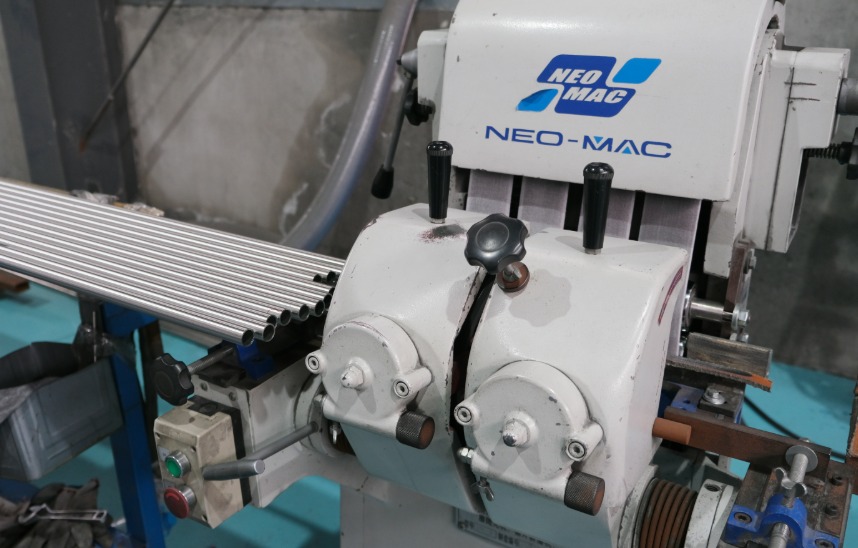
Neo-Mac Machine with Stainless Steel Tubes

Factory Tube Packaging Process

Industrial Manufacturing Equipment
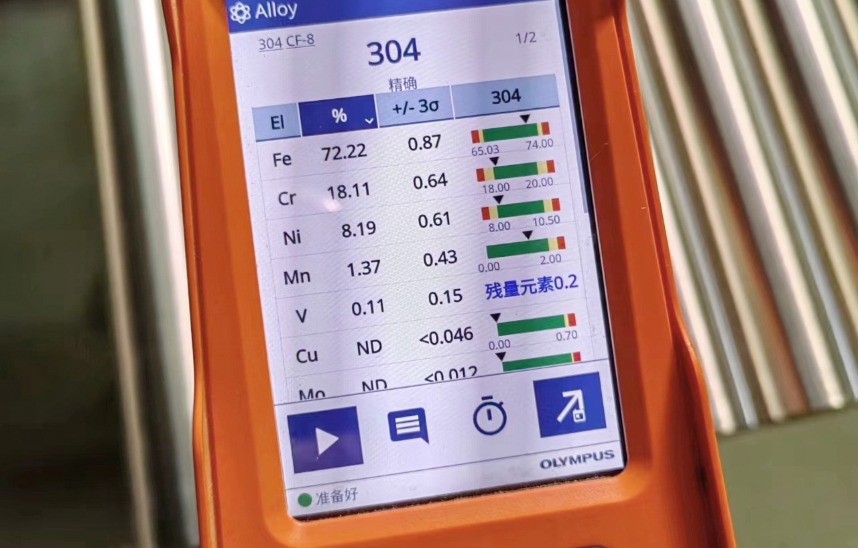
Stainless Steel Composition Analyzer
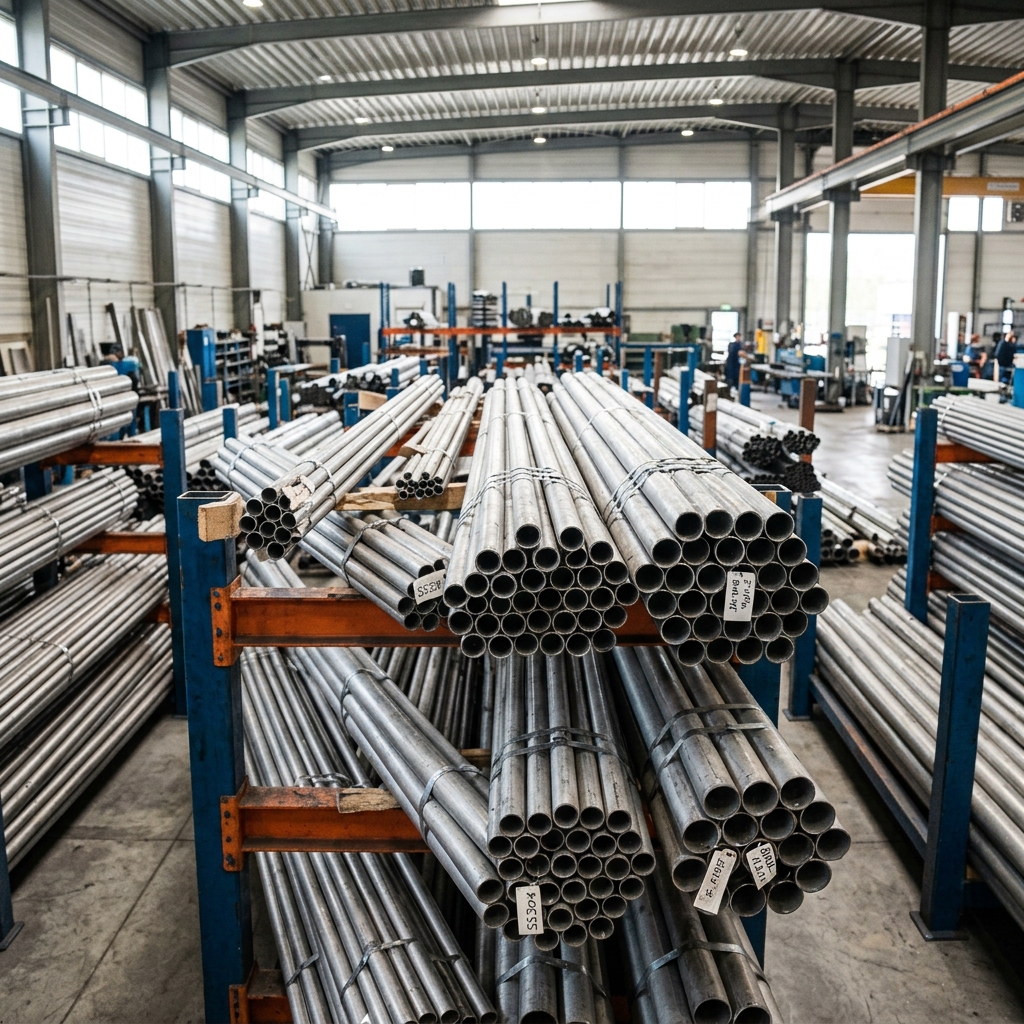
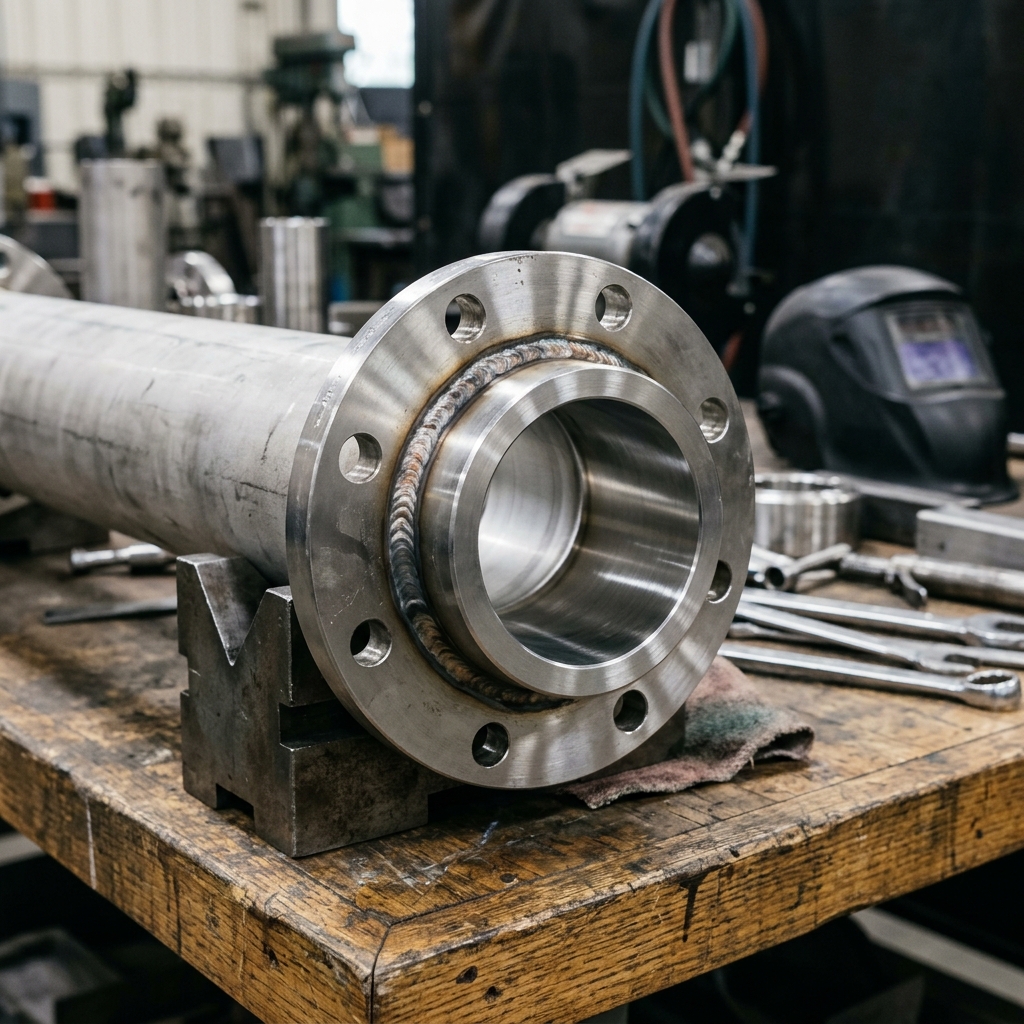
Stainless steel square tube is a hollow square section used for frames, structures, handrails, furniture and machine guarding. It is welded from strip and sized on its outside dimensions, so a 50x50 mm tube measures exactly 50 mm across each face. Walmay stocks it in 304 and 316L from 12x12 mm to 200x200 mm with walls from 1.0 mm to 6.0 mm, in mill 2B, No.4 brushed and mirror finishes, cut to length with square or mitred ends. Standard mill length is 6 metres.
The same product carries several names depending on where the drawing was produced.
| Name | Where used |
|---|---|
| Square tube | General and North American usage |
| SHS, square hollow section | European and Australian structural usage |
| HSS, hollow structural section | North American structural steel usage, covers square, rectangular and round |
| Box section | British trade usage |
| Square tubing | Common in fabrication and retail |
| Structural tubing | Generic, usually implies a structural standard rather than ornamental |
The names describe the same geometry, but the standard behind them matters: ASTM A554 covers ornamental and structural stainless tube with commercial tolerances, ASTM A500 and A1085 apply to carbon steel structural hollow sections, and EN 10219 covers cold-formed welded sections. For a stainless frame, A554 is the normal specification. Rectangular sections are on our rectangular tube page.
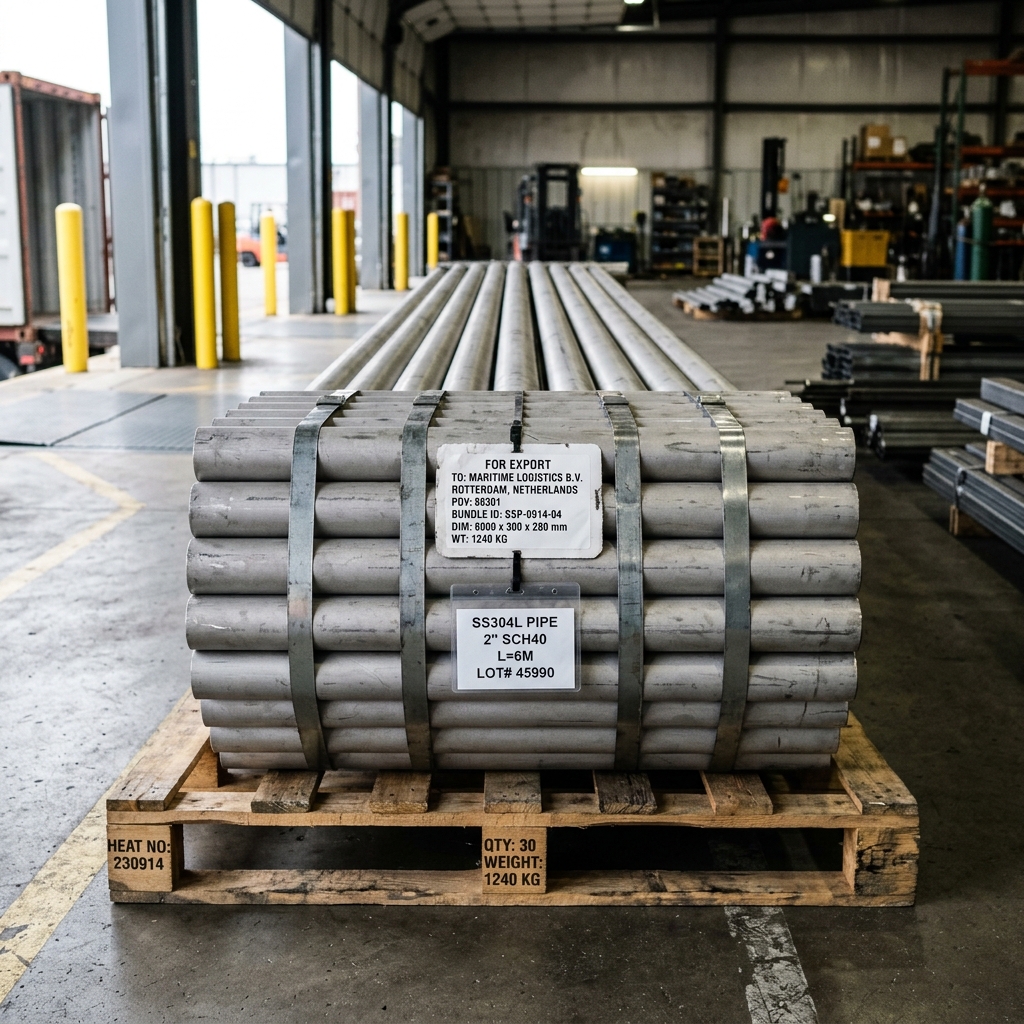
Square tube cuts cleanly on a bandsaw or a cold saw, and mitres well for corner joints. Three practical notes:
We supply tube cut, mitred, notched, drilled, bent, welded into frames and polished. See cutting, bending, welding, polishing and edge finishing, summarised on the fabrication page.
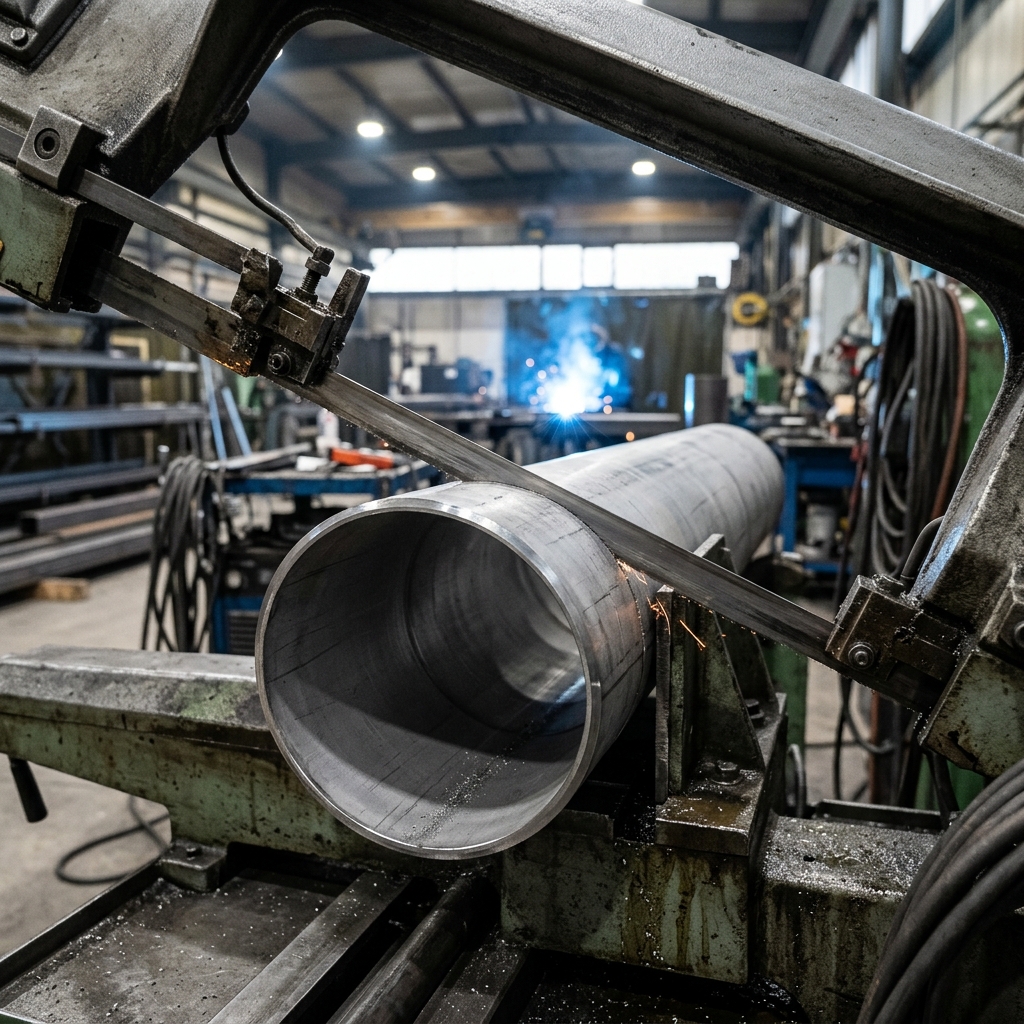
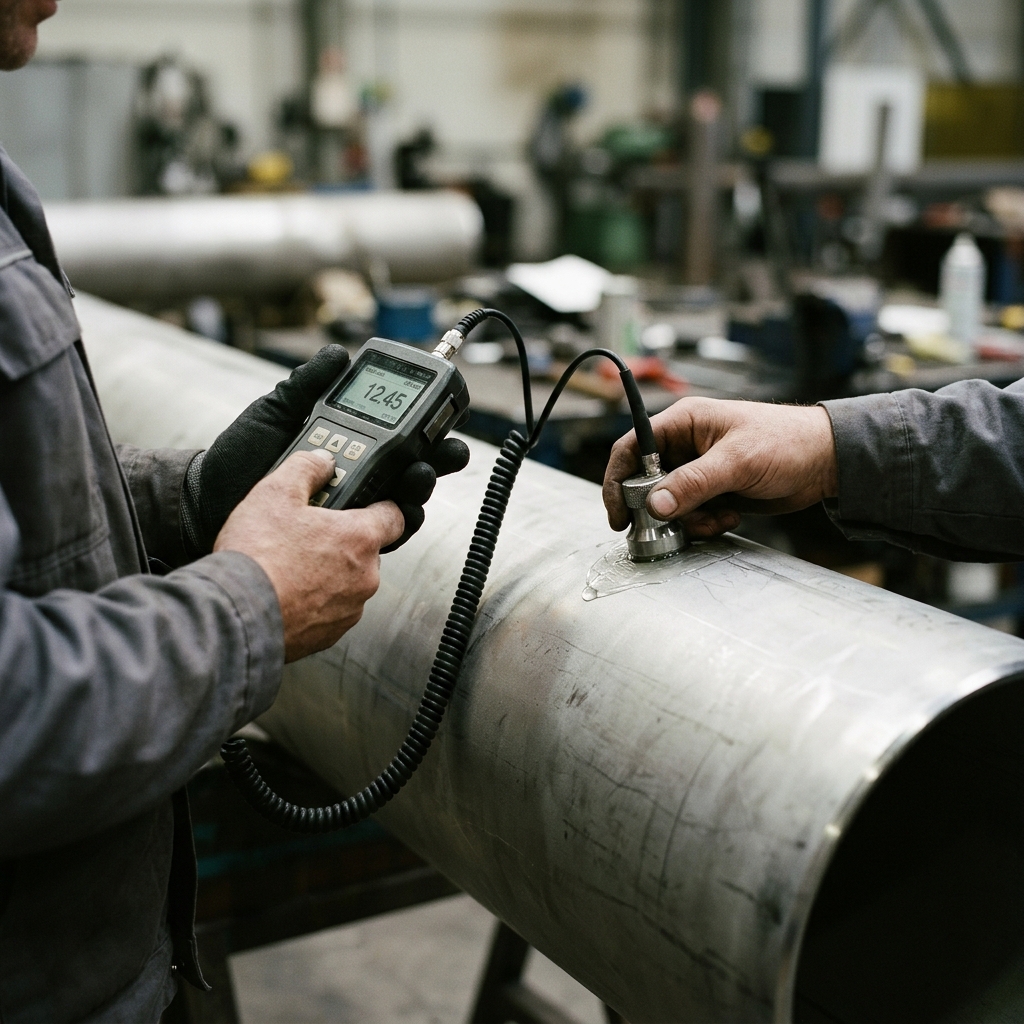


Walmay will help match the right stainless product form and specification for your application, confirm quantities and packing needs, and provide requested documents based on order requirements.
Loading form…